Problem
Soil is our most important resource. And it can no longer breathe.
Decades of intensive farming has compacted and degraded soils, reducing oxygen, drainage and suffocating crops, leaving soils unable to grow food and the world's largest terrestial carbon sink unable to store carbon.
And extreme weather is making things worse, faster.
Farming isn't built for the future.
4M+ ha
of farmland in the UK alone, is at risk of compaction
40%
of global soils are already degraded. 90% expected by 2050
95%
of food production still depends on soil
Farmers
globally, need a way to urgently restore soils and improve yields without sacrificing bottomlines
The technology
Autonomous aeration capsules for the future of regeneration & productivity.
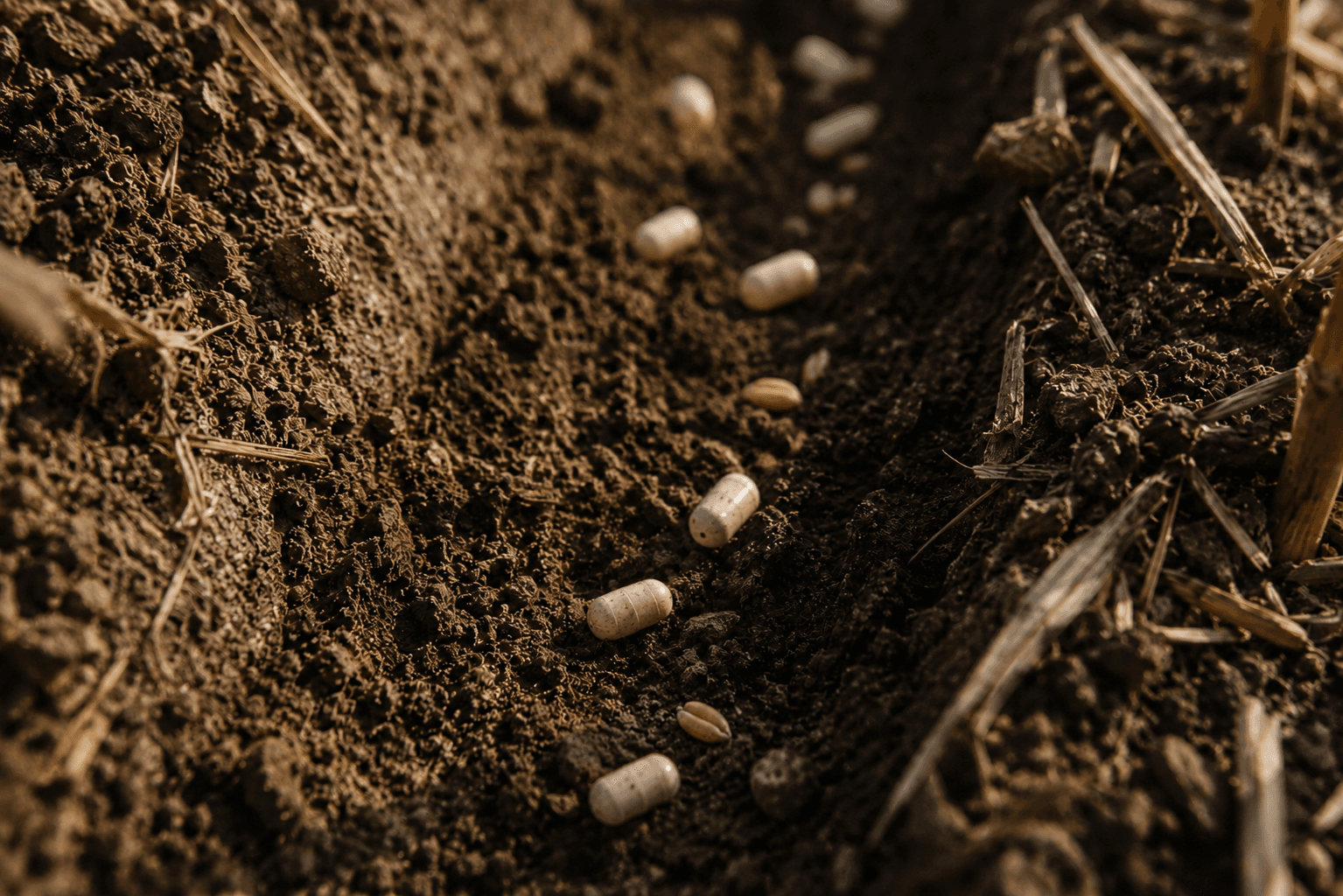
Aeropod is a nature-activated capsule designed to respond when soils and crops need it. When triggered, it gently breaks open soil from within, restoring its structure, oxygen flow and infiltration, while providing beneficial microbial inputs, creating conditions for soils to breathe again and regenerate, all season long.
We take a unique approach, starting with soil physics—the overlooked foundation its biology and chemistry depend on.
Just like fertilisers address chemistry and bio-inputs address biology, Aeropods introduce a novel, scalable agricultural input category for soil physics. The first-of-its kind.
By restoring structure without intensive machinery, Aeropod breaks the current centuries-long vicious cycle of physical damage, biological decline, and increasing chemical dependency leading to soil degradation.
And compared to one-off machinery, Aeropods work all season long, leading to significantly improved yield outcomes , meaning farmers no longer need to prioritise short-term productivity at the cost of longer-term productivity, removing barriers to regenerative agriculture.
Farmers can now heal their land without losing income, unlocking a future where productivity and regeneration can finally go hand-in-hand.
Designed to fit farmer workflows
Compatible with existing drilling machinery and sown alongside seeds every season.
Works throughout the season
Creates air, nutrient and water pathways underground, all season long.
Breaks down naturally
Biodegrades fully and safely to enrich soil biology for longer-term soil health.
Built to serve and scale
Built like a seed. Ships like a seed. Sows like a seed.
For farmers & growers.
Protect crop performance with structural improvement throughout the season.
For enterprise.
Reduce agricultural emissions and improve soil resilience across farms in your supply chains.
For distributors.
Add Aeropod's soil regeneration & yield improvement to existing products, distribution and farmer relationships.
For input partners.
A platform for emerging inputs. Create better physical conditions for biologicals, nutrients and other inputs and guarantee efficacy.
Our validation
Multi-award winning technology. Proven in early testing.
TRL 5
Validated in relevant environment and patent-pending
6x
More crop emergence than in compacted controls
30+
Inbound waitlist. In pilots with 4 farms and 2 distributors
19
Awards across design, sustainability and agriculture
Value propositions
Designed for both economic and environmental bottomlines.
Productivity
Go beyond intensive, expensive, one-off ploughing, while improving yields with continuous structural support throughout the season.
Input Efficiency
Make inputs work harder. Better soil structure creates better conditions for bio-inputs, infiltration and less runoff for water and nutrients, unlocking more from whats already going into the ground.
Sustainability
Regenerate soils while you grow. Reduce intensive intervention and fertiliser dependency, while supporting physical and biological soil health.
Regenerative & Net-zero transitions
Removes compaction yield-risk, a key barrier to regenerative transitions. Also cuts significant emissions from machinery use and nitrous oxide from compacted soils.